
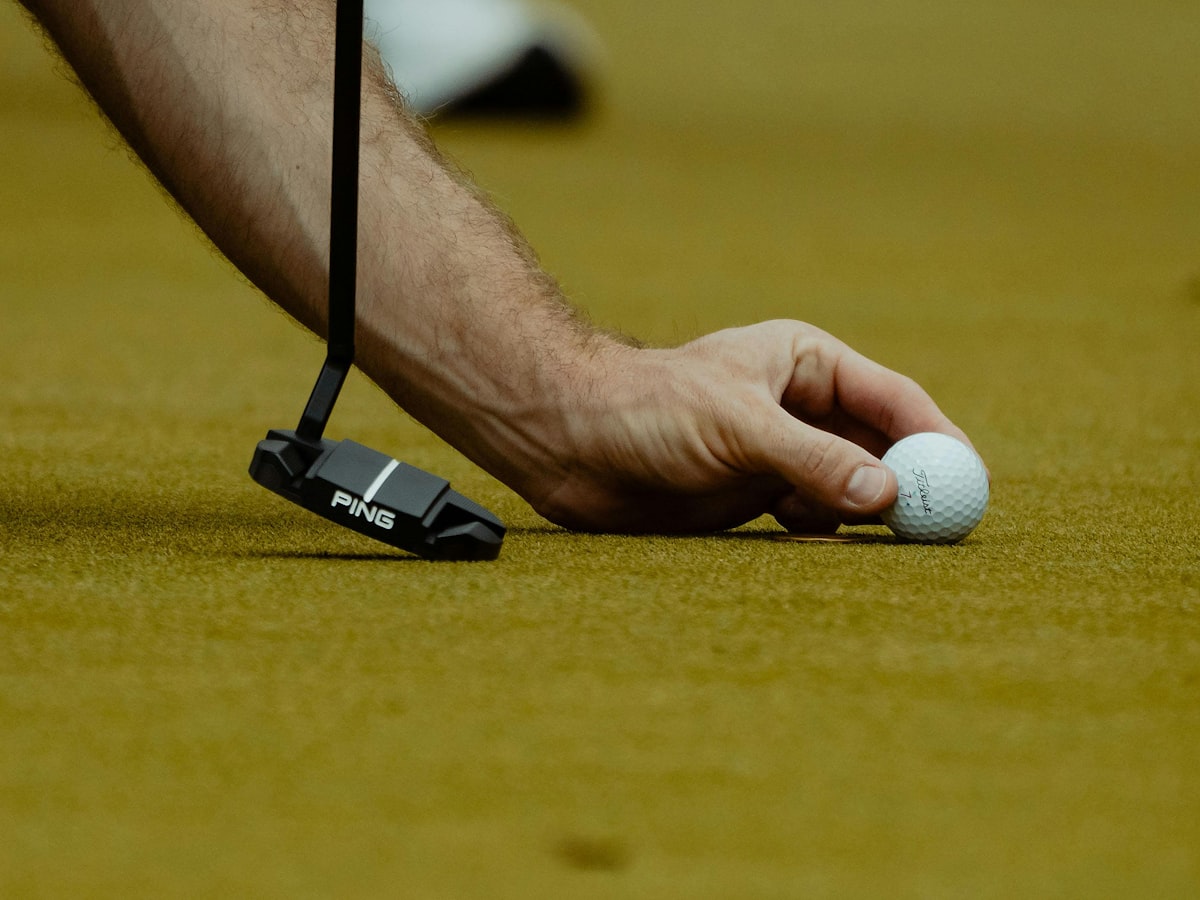
Walk down the practice putting green at any PGA Tour event now and you will see it inside the first minute: a player gripping down near the steel of an oversized, tapered putter grip, resting the whole length of it against their lead forearm, and rocking the ball into the hole with barely any hand action at all. Arm-lock putting has gone from a curiosity a handful of players tried in the mid-2010s to a mainstream method with real staying power, and the fact that it survived one of the biggest rule changes the sport has made in the last two decades is a large part of why.
Why it is legal when anchoring was banned
When the USGA and R&A introduced Rule 14-1b in 2016, banning putters anchored directly against the body, the fear among some players was that it would sweep up any technique that used the torso or forearm for stability. It did not. The governing bodies were specific from the outset that resting the shaft against the forearm, rather than pinning the grip against the chest or belly, would remain within the rules, because nothing is anchored to a fixed point on the body. The putter still has to be swung, not braced. There are limits written into the method itself: the grip cannot extend above the elbow, and a player cannot use the opposite hand to clamp the shaft against the forearm. Within those boundaries, arm-lock putting is simply a legal stroke, and it has stayed that way through every rules review since.
What it actually changes
The mechanical idea is simple enough. A conventional putting stroke relies on small, precise movements in the wrists and hands, which is exactly the machinery that tends to break down first when the pressure goes up. Lock the shaft against the forearm and grip down near the bottom of it, and the stroke becomes a larger, single-unit motion driven from the shoulders, with the hands and wrists mostly along for the ride. For a player who fights a handsy stroke, or who has watched a short putt get away from them at the worst possible moment, removing that small-muscle variable is the entire appeal. It does not make anyone a better read of break or a better judge of speed. It takes one specific failure mode off the table.
That trade-off is not free, which is worth saying plainly given how often arm-lock gets pitched as a cure. The clubs themselves are built differently, with a longer shaft, more loft to compensate for a steeper angle of attack, and a thicker, tapered grip that most players have never held in their hands before. Switching is closer to relearning the stroke than tweaking it, and plenty of players who try it in an off-season find the feel foreign enough that they go back. It has also drawn genuine criticism inside the professional game. Billy Horschel has been vocal in arguing the method should be banned outright, on the grounds that it gives players an advantage under pressure that a conventional stroke cannot match, and he is not alone in wanting the R&A and USGA to revisit it. For now, the governing bodies have shown no sign of doing so, and players including Bryson DeChambeau, Webb Simpson and Will Zalatoris have built it into their bag with no controversy attached to their own results.
Who it actually suits
This is not a method for every player who has three-putted once too often this season. It tends to help most the golfer whose stroke gets short and jabby from four feet in, the one who can feel their hands taking over as the putt gets shorter and the stakes get higher. If your longer putts are the issue, arm-lock does very little for you, because distance control on a thirty-footer is still a function of feel and speed, not stroke mechanics. It also demands a proper fitting rather than a shop-floor swap. The shaft length has to match your height and posture, the loft has to be built for the steeper stroke path the method produces, and the lie angle needs checking just as carefully as it would on a conventional putter. Buy one off the rack and you are as likely to introduce a new miss as fix an old one.
The honest way to think about arm-lock putting is as a specialist tool rather than an upgrade every golfer should chase. It solves a specific problem for a specific kind of player, and for that player, watching it hold up on Tour week after week is a reasonable reason to book a fitting and find out if it solves the same problem for them.