
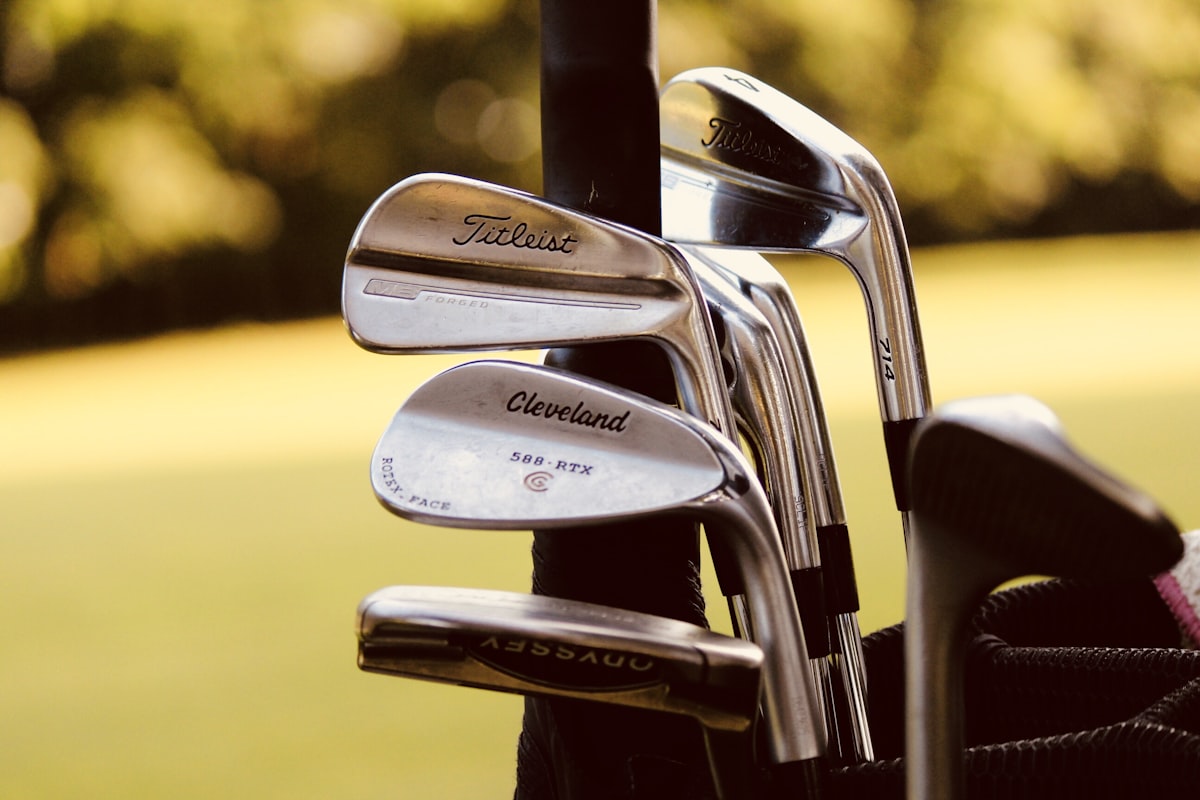
Ask most golfers how far they hit their seven iron and they will give you a number with great confidence. Ask them how far they hit the club between their pitching wedge and their sand wedge and you will usually get a pause, a frown, and an admission that they are not entirely sure they own one. That gap, the quiet no-man’s-land somewhere around a hundred yards, is where a surprising number of rounds quietly come apart. Gapping is the least glamorous part of equipment, which is precisely why so few people get it right.
What gapping actually means
The idea is simple. Every club in the bag should cover a distinct slice of yardage, and the slices should line up neatly so that whatever number you are faced with, there is a club that hits it with a normal, committed swing. In practice, almost nobody has this. The long end of the bag tends to bunch up, with a three wood and a five wood and a hybrid all flying within a few yards of each other, while the scoring end has a canyon between the pitching wedge and the next wedge down. The result is a set that is technically fourteen clubs but functionally more like ten, with the same shots repeated and the awkward distances left uncovered.
The cost of this is not dramatic. It is not a shank or a topped drive. It is the slow drip of half-clubs and forced swings, the eight iron you have to ease off because the full seven goes too far, the fifty-five-yard pitch you have no honest club for so you manufacture something and pull it left of the green. None of these are disasters on their own. Over eighteen holes they add up to two or three shots you never needed to lose.
Find your real numbers first
Before you can fix the gaps you have to know where they are, and that means finding your carry distances rather than your hopeful ones. The number that matters is how far the ball flies in the air, not the occasional firm-fairway roll-out you remember fondly. A launch monitor for half an hour is the honest way to do this, and most decent fitters or ranges now have one. Hit ten balls with each club, throw out the two best and the two worst, and average the rest. The figure that survives that process is your real carry number, and it is almost always shorter than the one you have been quoting.
What you are looking for as you write the numbers down is the size of each step. Through the irons the gaps should sit somewhere in the region of ten to fifteen yards, steady and even. The moment you see two clubs separated by four yards, or a yawning twenty-five-yard hole between two others, you have found the problem. The long irons and fairway woods are the usual offenders for bunching, and the top of the wedge ladder is the usual offender for a gap.
The wedge ladder is where most sets leak
If there is one place to start, it is the wedges, because that is where the gaps do the most damage to your score. These are the clubs you reach for inside scoring range, where a well-gapped set turns three putts into two and the occasional pitch into a tap-in. Yet most golfers carry a pitching wedge that came with their irons, lofted somewhere around forty-four or forty-five degrees, and then jump straight to a fifty-six. That is a gap of eleven or twelve degrees, which on the course translates to thirty yards or more with nothing in between.
The fix is to think in even loft steps rather than in club names. If your pitching wedge is forty-five degrees, a gap wedge around fifty and a sand wedge around fifty-four or fifty-five keep the steps sensible, and whether you add a lob wedge depends on whether you actually use one. Four to six degrees between wedges is the rule of thumb most fitters work to, and it is far more important than the brand stamped on the sole. A matched set of three honest wedges will save more shots than any amount of money spent at the other end of the bag.
The top of the bag deserves the same honesty
The longest clubs require the opposite instinct. Here the problem is rarely a gap and almost always an overlap. A three wood and a strong five wood and a two hybrid can all end up flying within a handful of yards of each other, which means two of those slots are doing the same job. The question to ask of every long club is not whether you can hit it but whether it covers a distance nothing else does. If the answer is no, it is taking up a place in the bag that a more useful club, or a properly gapped wedge, could fill.
None of this requires new equipment. Plenty of gapping problems are solved by bending a wedge a degree or two, dropping a redundant fairway wood, or simply learning the real numbers and trusting them. The point is to treat the fourteen clubs you carry as a system rather than a collection, so that every yardage you are likely to face has an honest, full-swing answer waiting in the bag. Get that right and the game gets quietly easier, which is the only kind of improvement that lasts.