
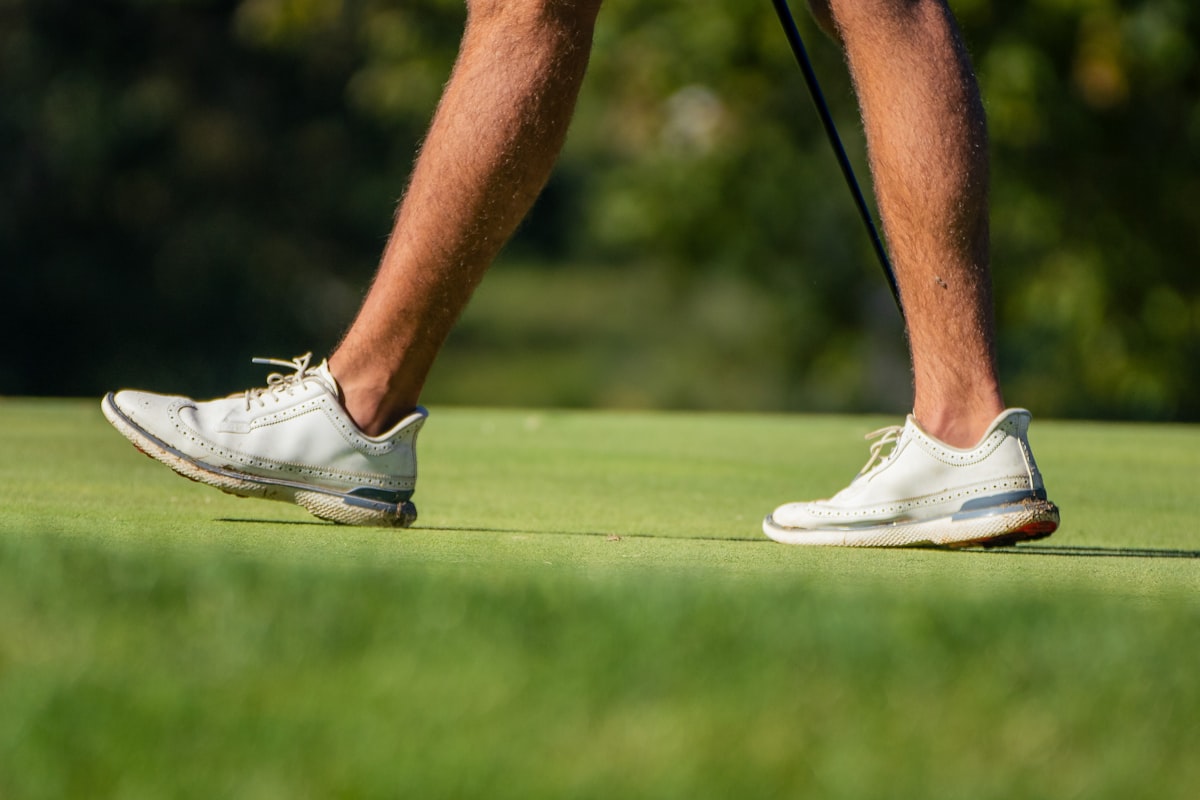
There is a piece of equipment in the game that touches the player for every minute of the four hours they are on the course, and that almost no amateur thinks about with any seriousness. The marketing budget for it is large. The fitting infrastructure for it is non-existent. The amateur conversation around it is, almost without exception, conducted on aesthetic grounds. The piece of equipment is the golf shoe, and the reason it matters has very little to do with what most amateurs think it has to do with.
The standard amateur theory of the golf shoe is that the shoe is a swing accessory. The right shoe holds the player’s lower body still through the swing. The wrong shoe slips at the moment of impact and turns a draw into a hook. The fitting question, accordingly, is whether the spikes grip the turf, and the answer to that question is almost always yes. Modern soft-spike technology, having been refined over twenty years of incremental tweaks, grips most lies that an amateur will encounter in most conditions. The swing-mechanics theory of the golf shoe, in 2026, is largely a solved problem. It has been a solved problem since around the time the metal spike disappeared from clubhouse rules.
The actual reason the golf shoe matters is the walk. A round of golf is between four and six miles on foot, depending on the course and the layout, and the shoe the amateur is walking those miles in is the most underconsidered piece of footwear the player owns. The trainers in the cupboard at home have been chosen with care. The walking boots have been fitted at the outdoor shop. The work shoes have been broken in over a year. The golf shoes, for most amateurs, were chosen on a Saturday afternoon at the pro shop on the basis of which colour was on sale, and they will be worn for ten miles next Saturday whether they fit or not. The result is a player who arrives on the eighth tee already tired, on the twelfth tee already sore, and on the sixteenth tee swinging a tired and sore version of their own swing. The bogey on seventeen is, in a quiet majority of amateur rounds, a footwear problem.
What the right shoe actually does
The right golf shoe does three things, none of them swing-related. It supports the foot through six miles of walking on uneven ground. It keeps the foot dry. It does not bruise, blister, or chafe across the course of a five-hour round. The shoe that does those three things well will produce, for almost any amateur, a measurable improvement in scoring on the back nine, because the player who is not tired hits the ball more cleanly than the player who is. The shoe that does those things poorly will produce the inverse. The shoe is a stamina question dressed up as a swing question.
The first of the three jobs is the most important. Walking five and a half miles on the rough side of a golf course is not the same as walking the same distance on a footpath. The ground rolls. The grass is wet at the edges. The lies on the slopes ask the foot to support a stance that the muscles of a sedentary modern player have not been asked to hold in a long time. A shoe with proper midsole support, a heel cup that cradles the foot rather than allowing it to roll, and a sole that bends at the ball of the foot rather than across the arch will produce a back nine in which the player’s legs are not the limiting factor. A shoe with thin midsole foam, no arch support, and a flat-bending sole will produce a back nine in which they are.
The second job, keeping the foot dry, is more important than the marketing suggests but slightly less important than the first job. Wet feet on a winter morning are the primary cause of the cold-weather hand grip tightening that sends a low draw five degrees right of target. Modern waterproof memberships and Gore-Tex linings handle this well in the better shoes and badly in the cheaper ones. The test, if you are buying for a player whose course is wet for half the year, is whether the shoe has a sealed seam at the toe and a tongue that is gusseted into the upper rather than stitched as a separate piece. Both details show up in shoes from the upper half of the price range. Neither tends to appear in the entry-level versions.
The third job, the not-blistering job, is a fitting question. Almost no amateur is fitted for golf shoes. The accepted method of buying a pair is to look at the size on the box, find the colour, and put the credit card down. The better method is to put both shoes on, walk for ten minutes around the shop, and pay attention to the heel, the ball of the foot, and the small toe. A shoe that rubs at the heel after ten minutes will rub for the next four hours. A shoe that pinches the small toe in the shop will produce a blister by the twelfth hole. A shoe that feels loose around the midfoot at standstill will feel looser through the lateral movement of a bunker shot. None of these problems are visible from the colour. All of them are visible from a ten-minute walk.
Spikeless versus spiked, and the false choice
The decision the modern shop assistant is most likely to ask the buyer to make is the choice between a spiked and a spikeless shoe, and the way the question is framed in the average pro shop is misleading. Spiked shoes, in the soft-spike era, are not significantly more grippy than the better spikeless shoes on most modern courses. Spikeless shoes, in the modern category, are not significantly less stable. The real choice is between a shoe that the player will wear only on the course and a shoe that the player will wear from the car park to the first tee, on and off the course, and in the clubhouse afterwards.
The decision should be made on the basis of the player’s travel pattern rather than on the basis of the swing. A player who walks from the locker room to the first tee, plays the round, and changes back into trainers at the end is best served by a properly spiked shoe with the most aggressive support and the most committed waterproofing the budget allows. A player who plays nine holes after work, drives to and from the course in the same shoe, and would rather not change is best served by a spikeless model with a sole that does not collapse on the third trip up the hill at the back of the practice green. Both kinds of shoe exist at every price point. The mistake the amateur tends to make is the inverse of the right one.
What to spend, and how to spend it
Golf shoes have a price ceiling that is, by the standards of golf equipment, mercifully low. The best shoe most amateurs will ever buy costs less than two hundred dollars. The cheapest shoe worth buying costs around eighty. The arithmetic of the purchase is therefore unusually friendly. A player who spends one hundred and fifty dollars on a shoe that fits, supports, and waterproofs properly will produce more golf-related comfort in a season than the same player spending the same money on any other piece of equipment in the bag. The shoe will last two to three seasons of regular play if rotated with a second pair, and one season if not.
The two-pair principle is the single most useful piece of footwear advice in the game. A pair of golf shoes that is allowed to dry out for forty-eight hours between rounds will last twice as long as a pair that is worn back-to-back on consecutive Saturdays. The midsole foam recovers between uses. The waterproof membrane recovers between uses. The leather upper, in the leather models, recovers between uses. The same pair worn twice in a weekend will be in the bin in nine months. Two pairs rotated will see the player out to three years.
The amateur game has, in this corner of the bag at least, a set of solved problems and a set of unsolved ones. The technology is solved. The fitting infrastructure is unsolved. The cure for the unsolved part is the player’s own attention to a ten-minute walk in the shop, a willingness to spend a moderate amount of money on the right pair, and the discipline to own two pairs and rotate them. The reward is a back nine that arrives with the player’s legs still under them. The bogey on seventeen, in the rounds that follow, becomes a par.