
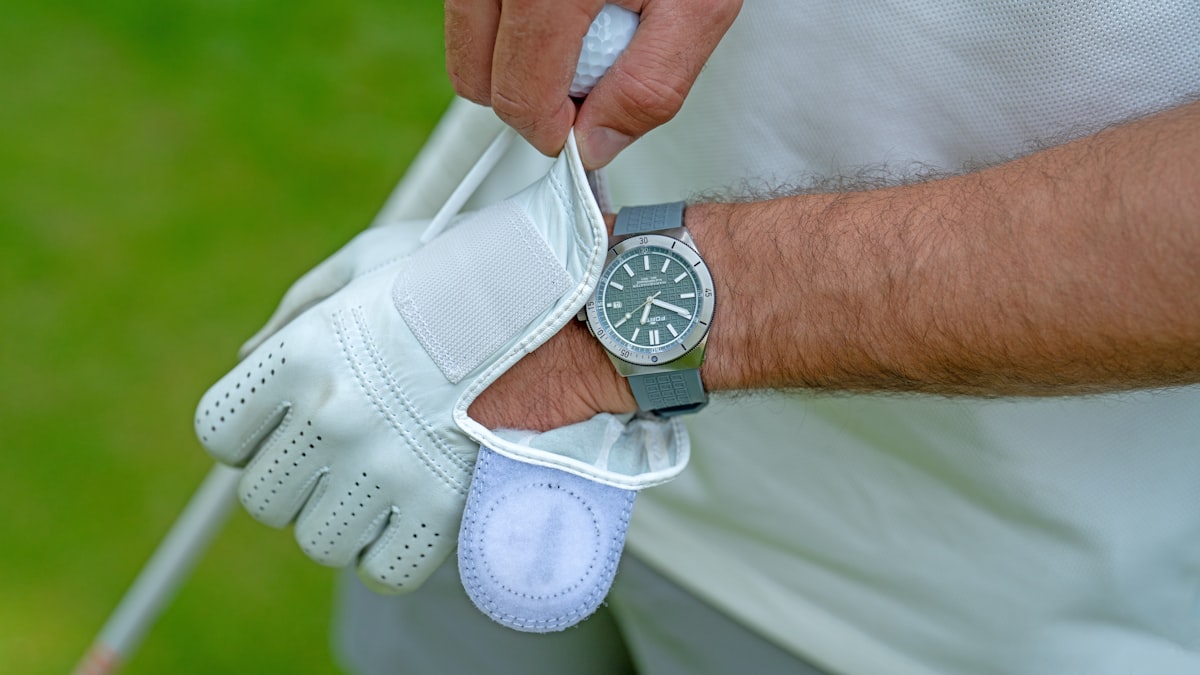
Of all the equipment decisions a recreational golfer makes, the glove is the one taken with the least thought. The driver is fitted on a launch monitor. The putter is fitted on a SAM PuttLab if the player is keen and on the carpet at home if he is not. The shoes are tried on, walked around in, and brought back if the heel slips. The glove, by contrast, is selected at the pro shop counter on the basis of “I think I’m a medium” and bought in the same size for fifteen years even after the hand of the player who bought it has gained or lost half an inch.
The result, for most amateurs, is a glove that is a half size too big. The leather across the back of the hand pulls when the wrists hinge. The webbing between the thumb and forefinger bunches at the top of the swing. The tab that fastens the cuff is positioned a fraction further down the wrist than it should be. None of which feels obviously wrong on the practice tee. All of which adds up to a glove that wears through at the heel pad twice as fast as a properly fitted one would.
The pinky test
The single most useful thing an amateur can do for his glove fit is the pinky test. Put the glove on. Pull the cuff down over the wrist as far as it will go. Look at the leather covering the small finger. If there is a quarter of an inch or more of empty leather beyond the tip of the finger, the glove is too big. The right fit has the leather pulled snug against the end of every finger when the hand is held flat. The cuff, when fastened, should be tight enough that there is no give in it when the wrist twists.
The reason this matters is not aesthetic. A glove that has slack in the fingers cannot transmit the torque of the swing through the leather without folding. The leather folds, the folds become creases, the creases become small abrasions, and the abrasions wear through the heel pad and the thumb in twenty rounds rather than the forty a properly fitted glove would manage. A glove that fits is also a glove that lasts.
The leather question
The honest equipment conversation in 2026 is between cabretta and synthetic. Cabretta, the soft sheepskin leather that has been the standard for tour gloves for as long as there have been tour gloves, is the better feeling material on the hand. It moulds to the hand within two or three rounds. It transmits the texture of the grip in a way that the synthetic alternatives have not yet matched. The trade-off is that it does not handle moisture. A cabretta glove caught in a rain shower will pull tight when it dries, will feel like cardboard in the next round, and will wear through within five rounds of getting wet.
The synthetic gloves on offer from FootJoy, Titleist, Callaway and Mizuno have closed most of the gap on feel. They handle moisture better. They last longer. They cost about the same as a mid-tier cabretta glove. The case for them is strongest for the player who walks in heat, plays in the rain, or sweats through his glove in the first three holes. The case against them is that they still feel slightly less alive on the grip than a fresh cabretta glove does, and that the feel of the grip is the one piece of feedback the swing needs more of, not less.
The compromise most tour players have arrived at is a cabretta in normal conditions and a synthetic for the rain. The compromise most amateurs would do well to arrive at is a cabretta they have actually fitted, used until it is properly worn through, and then replaced with another cabretta of the same size from the same manufacturer. The brand-and-size habit, applied consistently, will produce a better feel than chasing the latest model on a different label every season.
When to replace
The replaceable item in a golfer’s bag, more than any other, is the glove. The leather wears in patterns. The pattern that develops first is at the heel pad of the lead-hand glove, which is the part of the leather that contacts the rubber of the grip at the moment of impact. The pattern that develops next is at the base of the thumb, which is the part of the leather that contacts the rubber when the hand re-grips at the top of the swing. When either of those patterns goes through the leather and you can see the white of the lining, the glove is done. Continuing to use it is continuing to swing with a layer of friction-free fabric between the hand and the grip, which is the equivalent of a small slip in the same direction every shot.
A new glove costs about the same as a sleeve of mid-range balls. It has, for the player who pays attention, a more consistent effect on scoring than the ball does.
What to ask at the counter
The pro shop conversation, if you make the time for it, takes about three minutes. Ask for the cabretta glove in your usual size and a half size smaller. Try both on. Do the pinky test on each. Buy whichever passes. Then buy two more of the same size at the same time, because the size you have just identified is the one you will need in three rounds and again in seven, and the supply of any specific glove model in any specific size at any specific shop is, in our experience, never as reliable as you would like.
The glove is the cheapest piece of equipment in the bag and the one that touches the club every shot. Treating it as the throwaway it has somehow become is a small refusal to pay attention that costs more, over a season, than any of the bigger refusals to pay attention costs. A medium that should be a small does not look like much at the counter. It looks like the difference between a clean grip and a tired one for the second nine of every round all summer.