
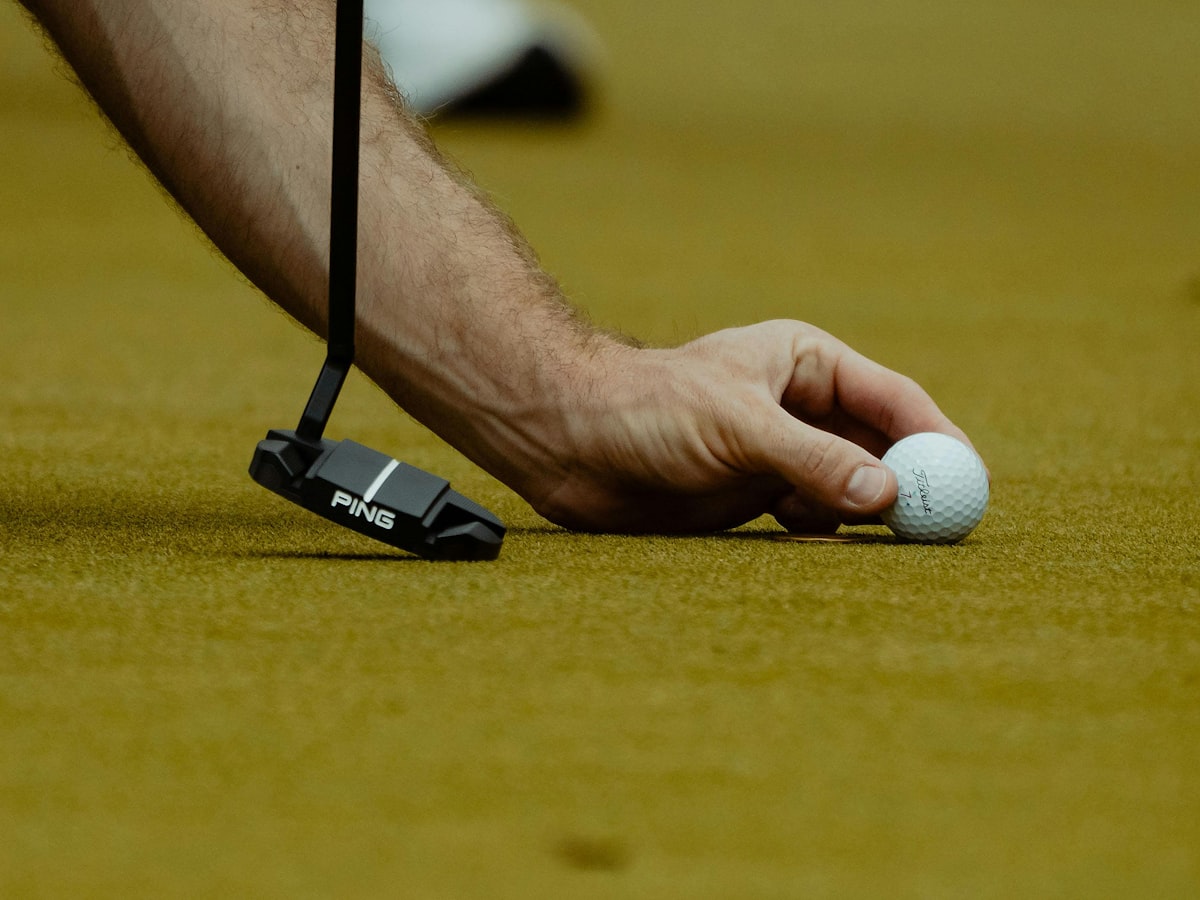
Watch any professional golfer crouch behind a putt on television and you could be forgiven for thinking that green reading is a kind of divination — a gift bestowed upon the talented few and forever withheld from the rest of us. It is not. Green reading is a skill, and like most skills in golf it responds to a framework, a bit of practice, and a willingness to look at the ground with slightly more attention than most of us currently give it.
Start with the big picture
The single most common mistake amateurs make when reading a putt is starting the process too close to the ball. They crouch behind it, stare at the line, and try to detect the break from a position where the information available to them is limited to what they can see in a narrow corridor between ball and hole. This is like trying to understand a painting by pressing your nose against the canvas.
The first thing to do, before you even think about the line of your putt, is to look at the green as a whole. Walk to a point where you can see the entire putting surface and ask yourself a simple question: where is the lowest point? Water runs downhill, and so does a golf ball. If you can identify the lowest point of the green — the drain, as some coaches call it — you have already solved half the puzzle, because every putt on that green will be influenced, to some degree, by the tilt towards that low point.
On most greens, the lowest point is obvious once you train yourself to look for it — usually at the front or to one side, because architects design greens to drain. Once you have found it, you know the general direction of the break for any putt on the green. A putt that crosses the slope will break towards the low point. A putt that runs directly towards it will be faster than it looks. A putt that runs away from it will be slower. This is not a complete reading, but it is a foundation, and it is more information than most amateurs use.
The walk tells you more than the crouch
The second most common mistake is reading a putt from only one position. The view from behind the ball is useful but incomplete. What it does not tell you is the slope between you and the hole, the subtle undulations that a low-angle view compresses into flatness, and the way the green tilts on the axis perpendicular to your line.
Walk the putt. Just walk from the ball to the hole, paying attention to what your feet tell you. Are you walking uphill or downhill? Does the ground tilt to one side? Your feet are surprisingly good slope detectors, far better than your eyes, and a brisk walk along the line will give you information that staring from behind the ball never will.
If you have time, walk to the low side of the putt and look at the line from there. This view shows you the slope in profile rather than head-on, and it is often the view that reveals the break most clearly. If the putt looks straight from behind the ball but obviously tilts when viewed from the side, trust the side view.
Speed before line
This is the piece of green-reading advice that transforms more scorecards than any other, and it is the one that amateurs most often ignore: the speed of the putt determines the line, not the other way around. A putt that is struck firmly will break less than a putt that is struck gently, because a faster ball spends less time under the influence of the slope. A putt that is dying into the hole will take every inch of the break. The same putt, struck two feet past the hole, might break half as much.
Decide on speed first. If you intend to die the ball into the hole, play more break than you think. If you plan to roll it a foot past, you can straighten the line slightly. Ten minutes on the practice green before your round — not aiming at a hole, just rolling balls across the surface and watching them curve — will tell you more about the speed of that day’s greens than any amount of theorising on the course.
Grain, and when to worry about it
Grain — the direction in which the grass grows — affects the speed and break of a putt, particularly on Bermuda greens common in the southern United States. The simplest way to detect grain is to look at the surface. If it appears shiny from behind the ball, the grass is growing away from you and the putt will be faster than the slope suggests. If it appears dark or matte, you are putting into the grain, and the putt will be slower.
If you play on greens where grain is a significant factor, add a grain check to your routine. If you play on bentgrass or poa annua surfaces where grain is minimal, do not overthink it. One of the quickest ways to ruin a putt is to stand over it cataloguing variables that are too small to matter.
A simple routine
Here, then, is a green-reading routine that takes no more than thirty seconds and incorporates the principles above. As you approach the green, identify the low point and note the general tilt of the surface. Walk from your ball to the hole, feeling the slope with your feet. Glance at the line from the low side if the putt is long or the break is ambiguous. Decide on your speed — how firmly you want to strike the ball and where you want it to finish if it misses. Let the speed determine the line. Trust the read, commit to the pace, and roll the ball.
There will be putts that do not behave the way you expected. That is fine. The difference between a good green reader and a poor one is not that the good one gets it right every time, but that the good one has a process, applies it consistently, and learns from the misreads. Over time, the speed becomes more instinctive, and the putts that once seemed like guesswork begin to feel like decisions. That, more than anything, is what reading greens well feels like: not certainty, but informed confidence.