
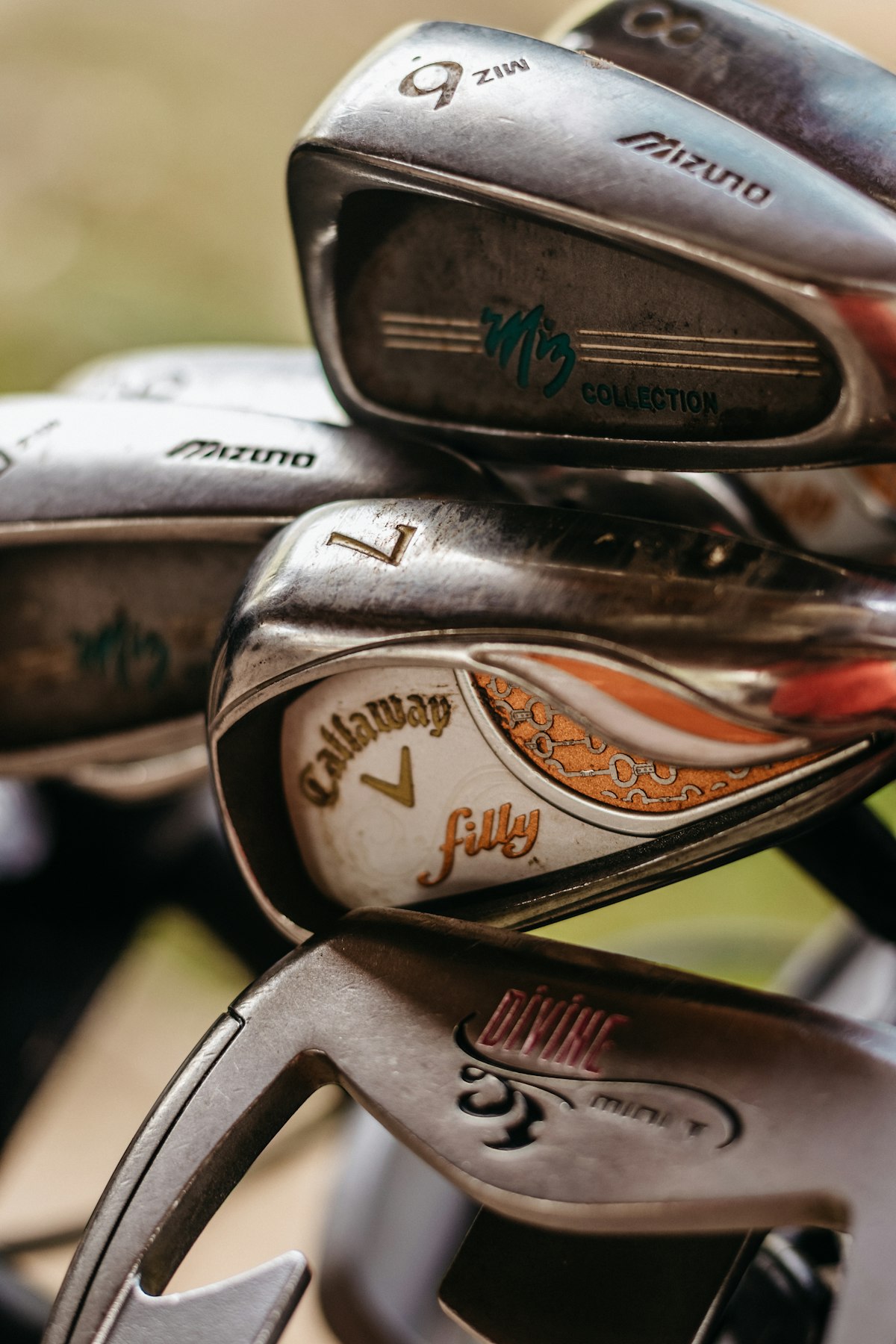
There is a club in your bag that you do not write home about. It is not the driver, with its crown the size of a soup bowl and its capacity to ruin a Saturday in two seconds flat. It is not the putter, which has its own carry-on travel case in the minds of most amateurs and its own spiritual relationship with the player who carries it. It is not even the wedge, which gets spoken about in tones reserved for fine dining. It is the 7-iron. The most quietly important club in the bag, and the one that, more than any other, will tell you the truth about your golf.
I have spent the last few seasons paying attention to the 7-iron in a way that most golfers do not, and the more I watch it the more convinced I become that the entire game is balanced on it. The driver is theatre. The putter is psychology. The wedge is craft. The 7-iron is the club where ball-striking, swing tempo, course management and ego all meet at once, and the result is a number on a scorecard that reflects who you actually are as a player rather than who you would like to be.
The honest distance
Ask a golfer how far he hits his driver and he will give you a number that is approximately correct on the days when everything is going well, and aspirational on every other day. Ask him how far he hits his 7-iron and you will get a much more honest answer. The 7-iron is the club that nobody bothers to lie about, because the lie is too easily exposed. You either carry it 155 yards or you do not. The yardage is consistent enough that one bad swing does not blow up the average, and important enough that the average has to be known.
This is the first thing the 7-iron tells you. It tells you what your real game is. The driver tells you what you are capable of on your best day. The 7-iron tells you what you can rely on when the day is not your best, which, statistically, is most days for most of us.
The diagnostic club
Coaches will tell you that if you want to know what is wrong with someone’s swing, watch them hit a 7-iron. The driver hides faults under sheer length. The wedge hides faults under sheer touch. The 3-iron hides faults under sheer impossibility — most amateurs cannot hit one cleanly enough for diagnosis to mean anything. The 7-iron sits exactly in the middle of the bag, which is to say it sits exactly in the middle of every pattern that defines the player who swings it.
If you cup your wrist at the top, the 7-iron will tell you. If you come over the top, the 7-iron will tell you. If your weight stays on your trail foot, the 7-iron will leak right and a bit short. If your tempo is rushing, the 7-iron will balloon and come up fifteen yards shy. The driver might have got away with all of these, and the wedge might have manufactured around them. The 7-iron does not lie. It produces a ball flight that is the visual equivalent of a swing analysis.
This is why the best teaching pros, when meeting a new student, almost always start with the 7-iron. Not because it is the most useful club to fix first, but because it is the club that will reveal what needs fixing. It is a diagnostic tool dressed up as a piece of sporting equipment.
The course-management cornerstone
There is also a strategic argument for the 7-iron, which is that it is the club that determines how aggressively or conservatively you can play any given golf course. A par-four where the second shot calls for a 7-iron is a par-four you can attack. A par-three where the yardage matches your 7-iron is a par-three where you should be expecting birdie chances rather than survival. A par-five where you can lay up to a 7-iron in is a par-five that has been demystified.
The good amateur thinks in 7-irons. He works backwards from the green, identifies the yardage that gives him a 7-iron in, and aims his tee shot at that yardage. The bad amateur thinks in drivers. He tries to get as close as possible and then figures out what is left, which usually leaves him with either a half-wedge that he cannot control or a long iron that he cannot hit. The 7-iron is the club around which the round should be planned, because it is the club that the average golfer hits most consistently.
The undersold modern club
The equipment industry does not love the 7-iron, because it is harder to sell. Drivers can be marketed on the basis of speed, distance, forgiveness, ten degrees of MOI graphs and player-tour-validation graphics. Putters can be marketed on the basis of feel, alignment, and the entire mystical lexicon of touch. The 7-iron is just a 7-iron. It does what it has always done. The improvements over the last decade have been real but incremental — better sole grinds, slightly more progressive offset, marginally better turf interaction — and they do not lend themselves to the kind of advertising campaigns that move units off shelves.
This is a shame, because the 7-iron is the club where modern fitting actually pays off the most. A 7-iron that is the wrong lie angle for you will miss greens by twenty feet on a regular basis, and you will have no idea why. A 7-iron with the wrong shaft will produce a flight that is either too low and too left or too high and too right, and again you will not know why. The fitting bay is the place where the 7-iron quietly transforms more handicaps than the driver bay does, and the industry under-talks it because the drama is not there.
The club that defines an era
If you want to understand how the professional game has changed, watch what happens at the 7-iron. Tour players hit their 7-iron about 190 yards now. Twenty years ago they hit it 175. Forty years ago they hit it 165. The march of distance shows up in the driver numbers because that is where the cameras are pointing, but it shows up in the 7-iron numbers in a way that has more direct consequences for how a course plays. A par-four where the world’s best players are hitting wedge into the green plays differently from a par-four where they are hitting 7-iron, and the courses on Tour have responded by lengthening to keep the 7-iron in play. The whole architectural arms race of the last quarter-century has, in a quiet way, been a fight to preserve the relevance of the 7-iron.
The amateur’s truest friend
In the end, the 7-iron deserves better press than it gets. It is the most consistent club in the bag for most players, the club around which the round should be built, the club that tells the truth about a swing, and the club that connects the amateur game most directly to the professional game. Hit a good 7-iron and you are, for that one swing, doing the same thing the world’s best players do. Hit a bad one and you have been told something useful about what to work on.
The next time you are at the range, give the driver a rest. Take a sleeve of balls and a 7-iron and spend twenty minutes hitting it. Notice the flight. Notice the consistency. Notice the yardage when you swing within yourself. The driver will be there next week. The 7-iron is the club that, more than any other, will quietly improve your golf if you let it.