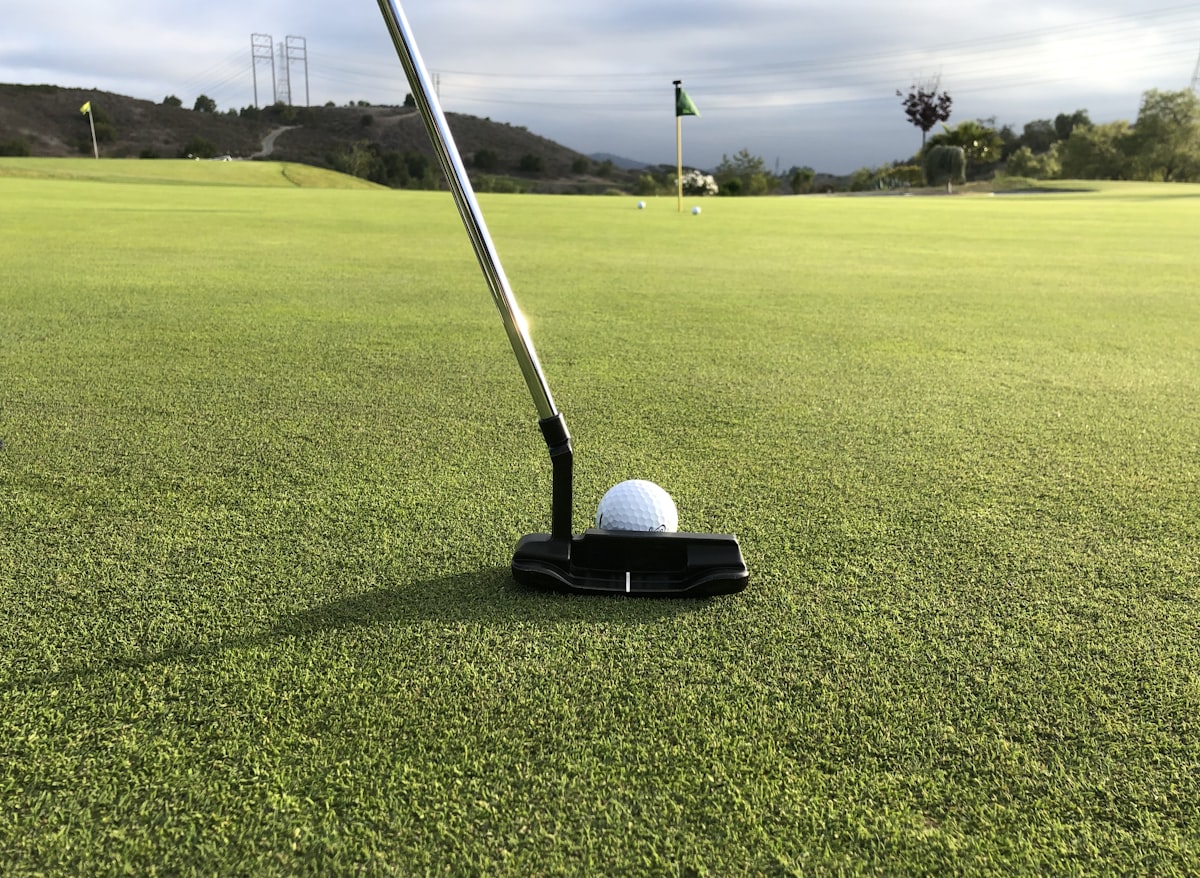
The amateurs I play with spend almost all of their pre-putt routine staring at the line. They squat behind the ball, they walk to the low side, they hold a finger up to the slope, and then they stand over a forty-foot putt and roll it nine feet past. The line was probably fine. The problem was always the pace, and the pace got about three seconds of attention.
This is the simplest improvement most club golfers could make to their scores, and it costs nothing. On any green that runs faster than about an eleven on the Stimp, the line of a long putt becomes almost a secondary concern. What matters is finishing the ball within a leave-able distance of the cup so that you are not staring down a knee-knocker on the way back. Pace is the variable that decides whether you walk off with a two-putt or a three.
The Tap-In Circle
Borrow an idea that good players use without thinking about it. Imagine a three-foot circle drawn around the hole. Your only job on a long putt is to land the ball inside that circle. Not in the cup, not eighteen inches from the cup, just inside the circle. If you do that consistently from forty feet, you will rarely three-putt, and you will start holing more of them than you expected because the dispersion happens to overlap with the hole on a fair number of attempts.
The reason this works is that it reframes the putt entirely. Instead of trying to make a forty-footer, which the brain knows is unlikely and so quietly tightens the hands and shortens the stroke, you are now trying to land a soft pitch into a generous landing area. The body relaxes. The stroke lengthens. The pace gets better almost on its own.
The Practice Drill That Actually Helps
Most putting practice is wasted on three-footers because three-footers are easy to make and feel productive. The practice that moves the needle is uncomfortable, and it lives in the long stuff. Here is the drill I keep coming back to.
Pick a hole on the practice green and find three positions, roughly thirty, forty-five, and sixty feet away. From each position, hit five putts. The only thing you are scoring is whether the ball stops inside an imaginary three-foot circle around the hole. Holed putts count as a success but do not count any extra. Putts that finish past the hole and putts that finish short both count as failures if they end outside the circle.
You will quickly notice two things. The first is that you have a strong directional bias. Most amateurs leave long putts short, and a few leave them consistently long. Both biases come from a misread of how the green is rolling rather than a flaw in the stroke itself. The second is that your tendency changes between uphill and downhill. Almost every amateur over-hits downhill putts and under-hits uphill ones. Knowing your bias is half the fix.
Reading Pace Off Your Feet
Here is the part that nobody seems to talk about. The best read of green speed you will ever get is the walk from your ball to the hole. Your feet feel the slope, the firmness of the surface, and the grain in a way that no amount of squatting and pointing ever will. Walk the line of the putt. Pay attention to whether the ground is going up or down under each step, where the grade flattens, and where it falls away. By the time you get back to your ball, you will know more about that putt than any read from behind the marker can give you.
This is not new advice. Bobby Jones wrote about it ninety years ago. But it has fallen out of fashion because television teaches us that the read is something done with your eyes from behind the ball, and most amateurs imitate what they see on television.
What You Can Skip
A confession. AimPoint, plumb-bobbing, ball-marker alignment lines, those side-eye reads from the low side of the cup, none of them matter as much as the pace does on a long putt. They are useful at six feet, where the line is the entire game. At forty feet they are noise. If you spent ten minutes a week on the long-putt drill above and stopped worrying about the rest, your scores would come down inside a month.
The next time you are standing over a long one on a quick green, do not ask yourself where it breaks. Ask yourself where you want it to stop. The answer is almost always the same. Inside the circle, hole-high if the slope allows, and walking up to a tap-in rather than a knee-knocker. That is what good lag putting is, and it is closer to a feel skill than a technical one. The good news is that feel can be trained, and the training is cheap.