
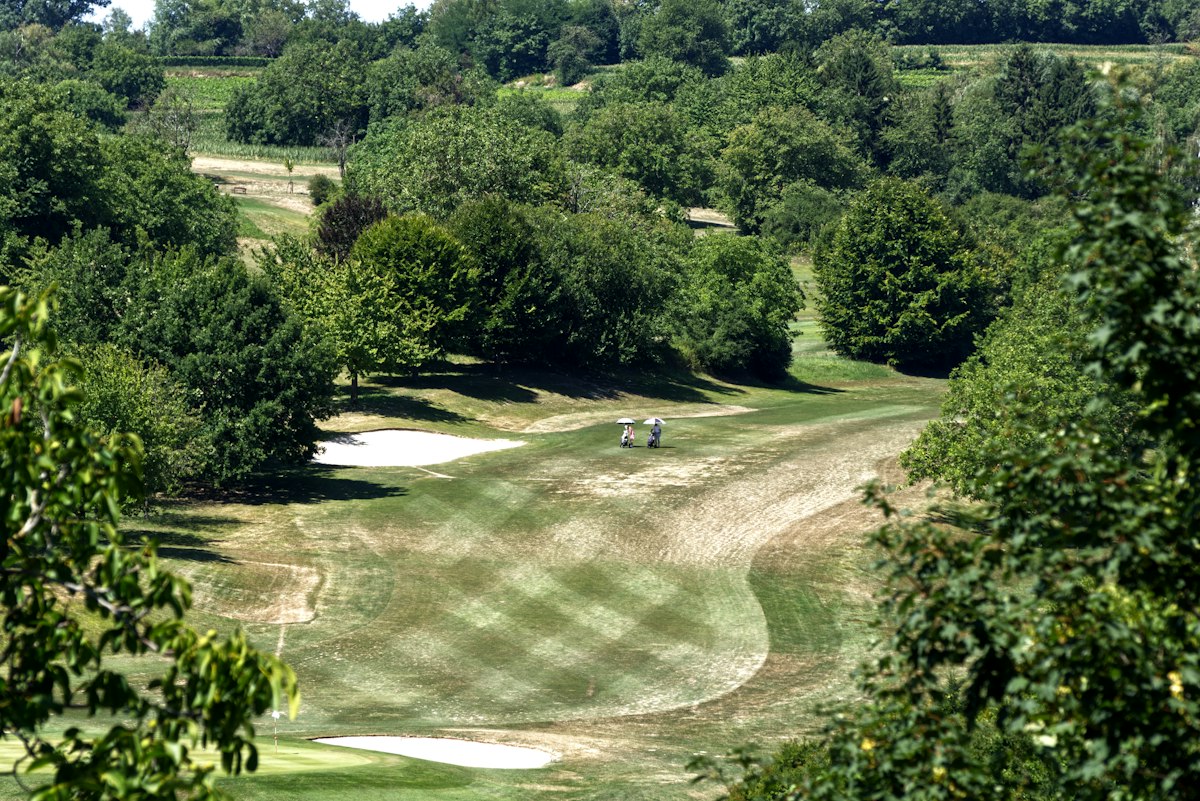
The par-4 16th at Pebble Beach Golf Links has always played the same small trick on you. Four hundred yards from the tips, gently downhill off the tee, and then an approach threaded between two Monterey cypress trees standing sentry about ninety yards short of the green, close enough together that generations of golfers have called them a pair of goal posts. Aim for the gap, and the hole opens up in front of you. Miss it, and you are punching out sideways wondering why a par 4 with no water in play has just cost you a shot. In early September, one of those goal posts came down. The tree on the right is simply gone now, and depending on which corner of golf social media you were reading last week, that removal was either a quiet piece of course maintenance or the first shot fired in a plot to soften Pebble Beach before the U.S. Open returns in 2027.
Justin Thomas landed firmly in the second camp before anyone had bothered to check. Commenting on a photo of the bare hole, he wrote that it made no sense to him why anyone would do this, adding that golf as a sport still has not learned that removing trees is not the answer to making courses better. It is a view Thomas has expressed before about other courses, and it comes from a defensible place: trees can be genuine strategic features, not just scenery, and a hole that has asked golfers to shape a shot around a natural obstacle for decades loses something real when that obstacle disappears. The trouble is that Thomas built his objection entirely on the assumption that this was a design decision. It was not.
The part almost nobody checked first
Pebble Beach’s own explanation, given to Golf Digest and confirmed separately to GOLF, is about as unglamorous as these things get. The cypress on the right of 16 had become diseased and infested beyond saving, despite two years of treatment, and a certified arborist recommended taking it out before the problem spread to the trees around it. That is the whole story. It was not the USGA clearing space for a wider fairway, a theory that spread fast enough on video platforms that a USGA spokesperson had to tell GOLF directly that the governing body had nothing to do with it. It was not Pebble Beach chasing a more shot-friendly look for the pros, either. A sick tree came down on the advice of the person whose job is to know when a tree is beyond saving, and the fact that it happened roughly a year out from a major championship at the same venue was coincidence, not conspiracy.
It is worth saying plainly that Thomas was not wrong to care about the principle. Golf has spent the past few years in the middle of a genuine wave of tree removal tied to Golden Age restorations, courses stripping back decades of overgrowth to recover the corridors and sightlines their original architects intended. Aronimink went through exactly that kind of large-scale clearing ahead of this year’s PGA Championship, and the online reaction followed the same script Pebble Beach just lived through: predictions that the course would play too easy, followed by a championship that produced a varied leaderboard and a winning score that stayed in single digits under par. Tree removal as a design philosophy is a live and reasonable debate in this sport. It simply was not the debate actually happening on Pebble’s 16th hole, and conflating the two let a maintenance decision get dragged into an argument it had nothing to do with.
What actually changes at Pebble before 2027
None of this is new territory for Pebble Beach specifically. The resort replaced the far more famous cypress on the 18th fairway a few years back, after the original was toppled in a 2014 ice storm, and that one, the tree standing sentinel beside the 18th green today, is itself a transplant brought over from the 1st hole after its predecessor died of pitch canker disease back in 2002. Courses on the Monterey Peninsula lose trees to weather and disease with some regularity. What made the 16th removal different was timing and platform: a photo landed in front of people already primed to read every course change through the lens of a U.S. Open a little over a year away, and a prominent player amplified the loudest interpretation before the quieter, more accurate one had a chance to circulate.
Pebble Beach has said it will stay in touch with its arborist about whether to plant something new in the gap, which for now means the hole plays as a slightly more open version of itself, without a firm decision on whether that changes permanently. Other tweaks are coming before the Open returns for a seventh time, some tee boxes shifted back, a handful of bunkers and greens rebuilt, though nothing on the scale that would make the course feel unfamiliar to anyone who has watched it on television for the past forty years. The tree will likely come up again next June, in a media center full of players walking the 16th tee for the first time since the change. Whether it plays any differently with the gap open is a fair question. Whether it was ever about making the course easier for anyone is not, and that distinction got lost for about a week in exactly the way these things tend to now, with a strong opinion travelling a great deal faster than the arborist’s report ever could.