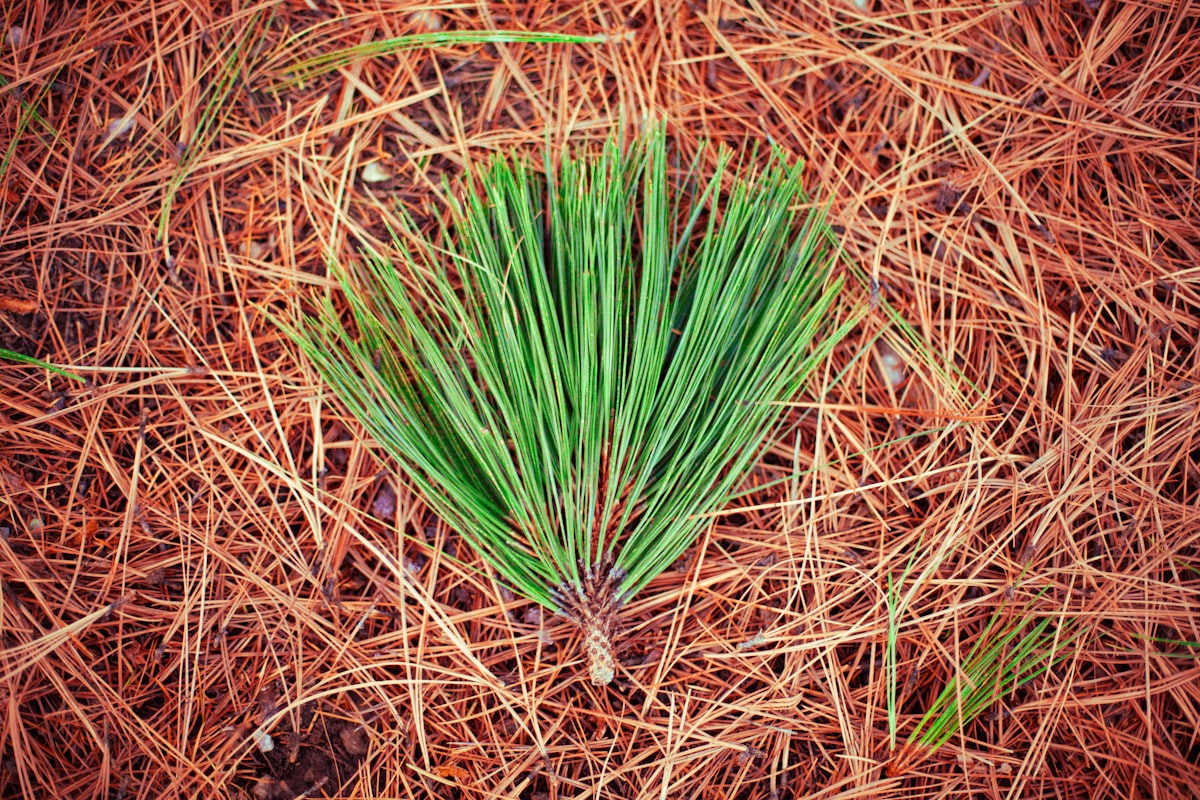
Watch enough Masters coverage and you will eventually see a Tour player standing on a bed of brown needles, head tilted, hands on hips, having a long quiet conversation with a caddie. Pine straw is one of the most common lies at Augusta and at any course cut through stands of mature pines, and it is also one of the most consistently misjudged lies in the recreational game. It looks soft. It plays anything but. The good news is that pine straw is not actually that hard to play from once you understand what it is doing to your club, your stance, and your contact. Here is how to think about it.
What pine straw actually does
Pine straw is loose. That is the whole story, and everything else flows from it. The needles do not anchor your feet, they do not anchor the ball, and they certainly do not anchor your club. If you ground your club at address and a single needle moves, you have caused the ball to move under the rules and you can be looking at a penalty stroke before you have even taken the club back. So step one, before anything technical, is hovering the club. Just keep it off the ground entirely.
The ball itself is usually sitting on top of the needles rather than nestled into them. This is good news. It means you can make clean contact with very little debris between the clubface and the ball, provided you do not change your angle of attack. The most common mistake amateurs make from pine straw is trying to scoop the ball off the bed of needles, which forces a thin or fat strike depending on which way the needles slide.
The setup that works
Treat the shot the way you would treat a fairway lie, with two adjustments. First, narrow your stance very slightly, perhaps an inch off your normal width. The reason is balance: pine straw shifts under your feet during the swing, and a narrower base helps you stay centred over the ball. Second, position the ball just a touch back of where you would normally play it. Half a ball width is plenty. This encourages a slightly steeper attack and ensures the club meets the ball before it meets the needles.
Hover the club. Take one practice swing well away from your ball, just to feel the surface, and notice what your trail foot wants to do as you turn back. If it slips at all, narrow your stance another half inch. Trust the lie. The ball is sitting up.
Club selection and the “one less” rule
Pine straw is almost always under tree cover, which means trajectory matters as much as distance. Before you choose a club, look up. The ceiling between you and your target is the real constraint on this shot, not the yardage. A 7-iron that you cannot get under the bottom branch of an overhanging pine is no use to anyone.
Once you have established your trajectory window, pick the club one less than your normal yardage and play a controlled three-quarter swing. The reason is twofold: a smoother tempo protects your balance on the loose surface, and a slightly longer club lets you keep the ball flight down without having to manipulate your hands through impact. If you are 150 yards out and that is a normal 7-iron for you, take a 6-iron and swing at 80 percent. The result is a piercing, controlled ball flight that holds its line into wind and lands soft enough to stop on a green.
When to attack and when to retreat
Here is the unglamorous part. Pine straw is recovery territory, and the first question to ask is whether recovery means attacking the green or simply getting back into the fairway. Tour players go for the green from pine straw because they have the ball-striking and the trajectory control to do so. Most amateurs do not. There is no shame in punching out sideways with a low 8-iron back to the short grass, taking your medicine, and trying to get up and down for bogey.
A useful rule of thumb: if you cannot see at least three quarters of the green from your stance, the percentage play is to chip out. If you can see the green and there is no significant tree in your line, you can consider a longer shot, but only if the lie is sitting up cleanly and the trajectory ceiling allows for it. The hardest shot in golf is the one you talk yourself into hitting because you do not want to look like you are giving up.
A short word on bunkers and pine straw
If your shot from pine straw needs to carry a fairway bunker on its way to the green, do not bother. The combination of an unstable surface, a tight trajectory window, and a forced carry over sand is the textbook setup for a double bogey. Take the punch out, leave yourself a full wedge, and move on with your round.
The short version
Hover the club. Narrow the stance. Move the ball back a touch. Take one more club than you think and swing at three-quarters. Look up before you commit to a target. And remember that pine straw is a recovery shot, which means the goal is to get back to safety, not to manufacture a hero. Play it that way and you will leave Augusta-style trouble behind a lot more often than you would expect.