
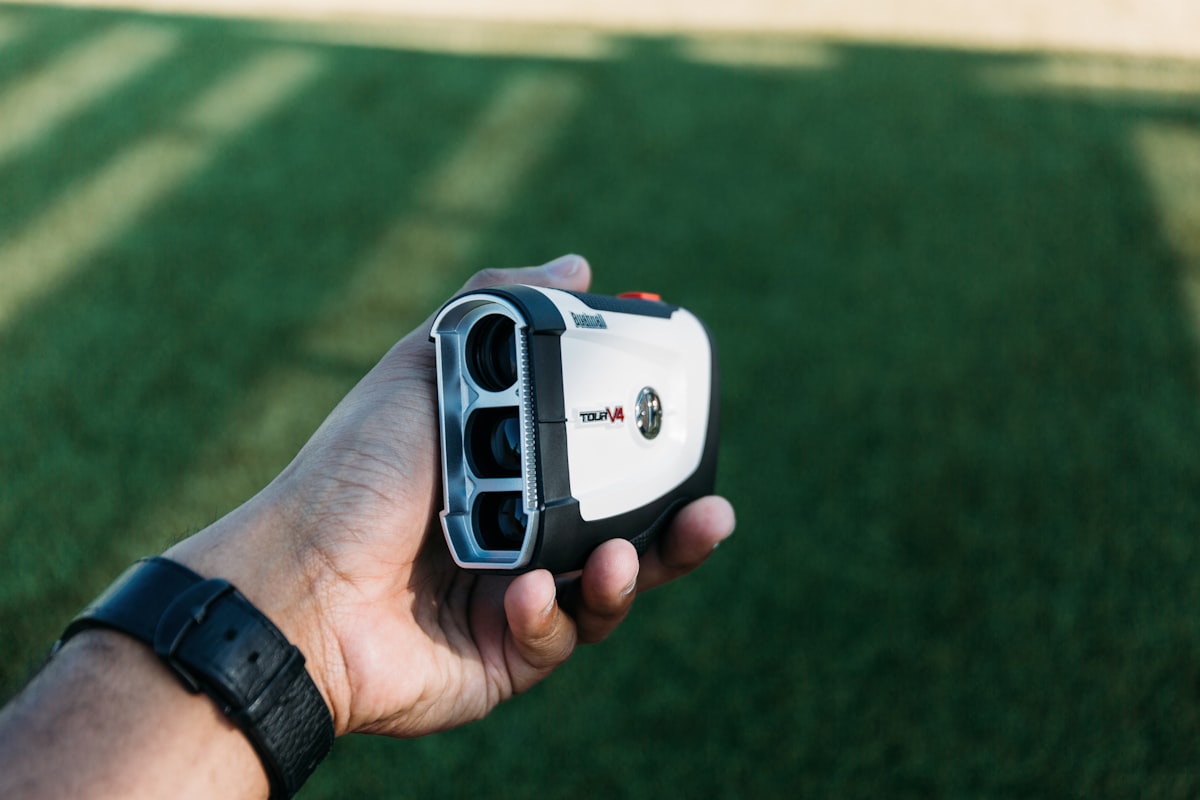
There was a time, not so long ago, when knowing the distance to the flag meant finding a sprinkler head, squinting at a yardage marker, or trusting the course guide that came with your buggy and may or may not have been updated since the Clinton administration. That era is over. The modern golfer has two primary tools for getting an accurate number: the laser rangefinder and the GPS watch. Both work. Both have fervent advocates. And if you spend any time on golf forums or in the pro shop queue, you will encounter people who are absolutely certain that one is superior to the other and that anyone who disagrees is playing the game incorrectly.
The truth, as usual, is more nuanced than that. The right device depends on how you play, how quickly you play, and what kind of information you actually use when you are standing over the ball.
What a rangefinder does well
A laser rangefinder gives you a precise distance to whatever you point it at. Aim at the flag, press the button, and you get a number — typically accurate to within a yard. The better models include slope compensation, which adjusts the reading for elevation change, so a 150-yard shot that plays uphill to an elevated green might read as 157 yards to the effective playing distance. On a hilly course, that adjusted number is genuinely useful. On a flat links, it matters rather less.
The rangefinder’s great strength is specificity. You are not getting a distance to the centre of the green and then doing mental arithmetic to account for a front pin. You are getting a distance to the pin itself, right now, on this particular Tuesday or Saturday. If the flag is tucked two paces from the front edge, the rangefinder tells you that. If it is buried at the back behind a bunker, the rangefinder tells you that too. For approach shots, particularly from 100 to 200 yards where the difference between the front and back of a green can be two full clubs, that precision matters.
The weakness is pace. A rangefinder takes a few seconds to pull from the bag or pocket, aim, lock onto the flag, and read the number. On a busy course with a group behind you, those seconds add up, and the golfer who lasers every shot — the flag, the bunker, the tree on the left, the sprinkler head for confirmation — is the golfer whose playing partners are quietly losing patience. There is also the issue of line of sight: if you cannot see the flag, you cannot range it, which happens more often than you might expect on dogleg holes, blind approaches, and courses with undulating terrain.
What a GPS watch does well
A GPS watch gives you distances to the front, middle, and back of the green — and on most models, distances to hazards, layup targets, and the edges of fairway bunkers — without requiring you to do anything except glance at your wrist. The information is there before you reach your ball. You do not need to find the flag, aim a device, or wait for a reading. You look down, see that the front edge is 142 and the back is 168, and you start thinking about club selection while you are still walking up the fairway.
The speed advantage is significant. A GPS watch adds zero seconds to your routine because the data is passive — it updates as you move, and it is waiting for you when you arrive at your ball. On a course you have never played before, the hazard information is particularly valuable. Knowing that the fairway bunker on the right is 235 to carry and 260 to clear, before you have even seen the hole, lets you make a tee shot decision without guessing.
The weakness is that the distance is to a fixed point — the centre of the green, or a mapped feature — not to the flag. A GPS watch does not know where the pin is today. If you have a front-centre distance of 148 and the pin is at the back, you need to add yardage yourself. Most competent golfers can estimate this well enough, but it is an estimate, and on a day where the pins are tucked into corners and the greens are firm, an estimate is not always sufficient.
Some newer watches do offer pin-position integration through apps or course-specific updates, but the accuracy of these features varies, and they tend to work best at well-known courses that are frequently updated. At your local municipal, the pin position on the watch may bear only a loose relationship to the pin position on the course.
The case for carrying both
A surprising number of serious amateurs carry both devices, which sounds like overkill until you think about how they complement each other. The GPS watch handles the strategic decisions: distances to hazards off the tee, layup numbers on par fives, a quick reference for the general shape of the green. The rangefinder handles the precision work: the exact distance to the flag on approach shots, the carry number to a front bunker when you are deciding between a 7-iron and an 8-iron.
In practice, this means the watch does most of the work and the rangefinder comes out perhaps six or seven times a round — for the approach shots where pin-precise yardage genuinely changes the club you hit. That is a reasonable balance between pace and precision, and it avoids the most common complaint about rangefinder-only golfers, which is that they laser everything including the halfway house.
What to look for in each
If you are buying a rangefinder, the features that matter are speed of lock (how quickly it finds the flag), slope mode with a clear indicator showing when slope is on or off (since slope-adjusted distances are not permitted in competition under the Rules of Golf unless the committee allows it), and magnification. A 6x or 7x magnification is standard and sufficient for most situations. Spend your money on a model with reliable flag-lock technology — the feature that vibrates or flashes when the laser has locked onto the flag rather than a tree behind it — because without that, you will spend your life wondering whether you just ranged the flag or the hospitality tent.
If you are buying a GPS watch, the features that matter are course coverage (does it have your local courses pre-loaded and regularly updated), readability in direct sunlight (an issue that separates the good watches from the frustrating ones), and battery life. A watch that dies on the 14th hole is worse than no watch at all, because you have spent thirteen holes relying on it and have forgotten how to read a sprinkler head. Look for a model that comfortably lasts 18 holes in GPS mode with at least 20 percent battery remaining. If it doubles as a regular fitness watch, all the better — you are more likely to wear it consistently, and a device you wear every day is a device you remember to charge.
The bottom line
If you play once a week at the same course and know the yardages reasonably well, a GPS watch is probably sufficient. The front-middle-back numbers will confirm what you already suspect, the hazard data is useful on the occasional away day, and the watch will not slow you down.
If you play competitive golf, travel to unfamiliar courses regularly, or find that your approach play is the weakest part of your game, a rangefinder is worth the investment. The precision it provides on approach shots — the shots where the difference between a good number and a rough guess is the difference between a birdie putt and a bunker shot — pays for itself over time.
And if you play enough golf that both devices would see regular use, carry both. The watch for strategy, the rangefinder for execution. Between them, you will never stand over an approach shot wondering whether it is a hard 8 or a soft 7, and in a game defined by margins, removing that uncertainty is worth whatever the devices cost.