
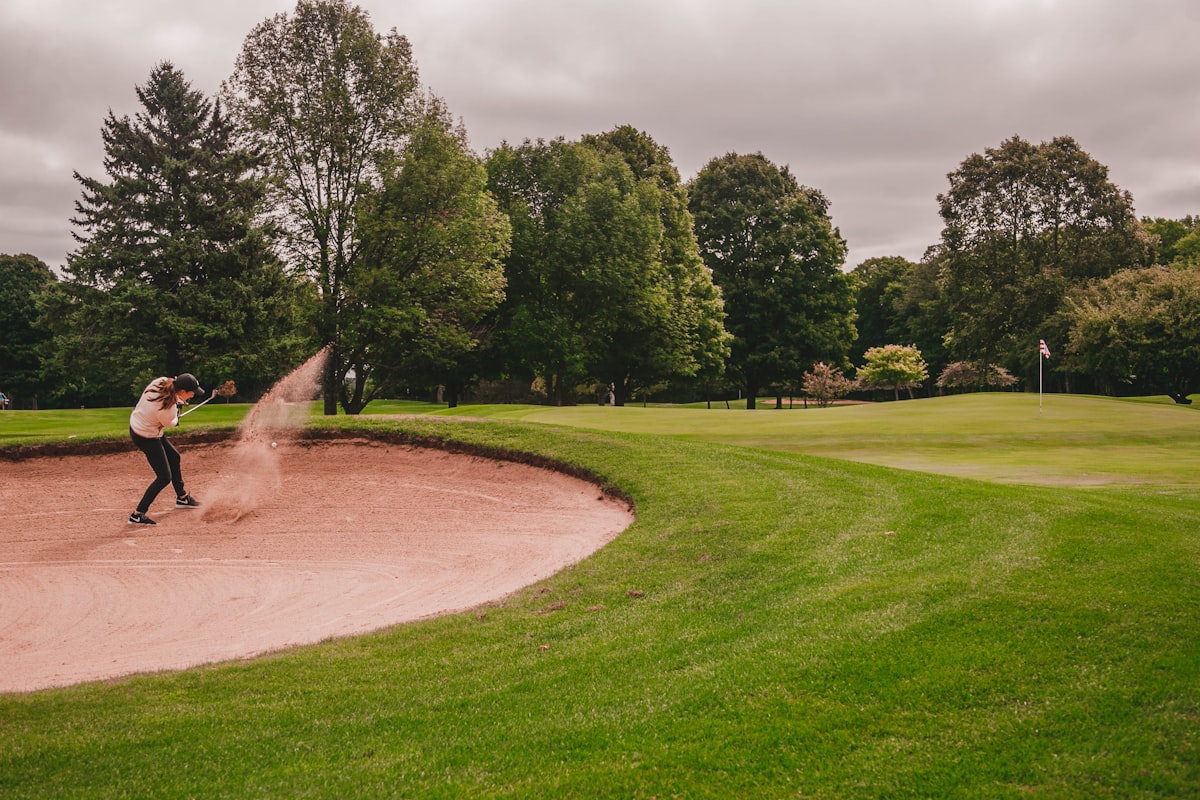
The PGA Tour has decided, again, to try to fix slow play with punishment. Starting on the Korn Ferry Tour, pace-of-play data is being made public for the first time, average stroke times attached to names rather than buried in a rules official’s clipboard. A revised penalty structure sits alongside it: one bad time costs a shot, two costs another, and a third can mean disqualification, a stiffer ladder than the Tour has actually enforced in almost nine years. Rangefinders have been trialled at six events between the Masters and the PGA Championship. Lucas Glover has taken aim at AimPoint reading as “pretty sluggish,” and Matt Fitzpatrick was caught on an NBC broadcast at the Valspar visibly frustrated by a playing partner who could not get out of his own way. All of it treats slow play as a discipline problem, something to be coached or fined out of individual players. Watch an Open Championship on a firm, fast links course and it becomes obvious that the Tour has been solving the wrong half of the equation.
The course decides more than the player does
Royal Birkdale this week is playing about as fast and firm as a links course can, the product of a rainless forecast and fairways narrowed by a 2024 renovation. Players describe the ball running out for what feels like forever off the tee, six-irons travelling 280 yards downwind, approach shots run along the ground into greens rather than flown at them. It is, among other things, quick golf. There is less rough to search because the rough has burnt out. There is less deliberation over club selection because the ground game removes half the options a soft course would offer. A links round in weather like this can move at a pace that would embarrass most PGA Tour Thursdays, not because the players are trying harder to hurry, but because the course has taken several of the slowest decisions out of their hands.
Compare that to the setups that produce the five-and-a-half-hour rounds the Tour is now trying to legislate against. Lightning-fast greens that punish anything but a perfectly read putt. Deep, healthy rough that turns every miss into a five-minute search-and-recovery mission. Pin positions tucked so tightly against slopes that a wrong miss brings a penalty stroke of its own. Add a full field, a walk-and-wait format, and cameras on every group, and you have built an environment where deliberate play is not a character flaw but a rational response to the incentives on the ground. Punishing the player for behaving rationally inside a system designed to reward caution treats the symptom and leaves the disease alone.
Rangefinders and public shame will only get you so far
None of this is an argument against the Tour’s new measures. Public pace data at least puts real information in front of fans instead of vague complaints about a “sluggish” group, and a penalty that actually gets applied carries more weight than one that has sat unused for nine years. Rangefinders should shave some real time off the yardage-and-conversation ritual that eats minutes on every approach shot. But none of it touches green speeds, rough height, pin difficulty, or field size, the four levers that do more to set the pace of a round before a single player has stepped to the tee. LIV Golf’s shotgun starts and forty-eight-man fields produce sub-four-hour rounds partly because of format, but also because a smaller field with a gentler setup simply asks fewer agonising decisions of the players in it.
What Birkdale is quietly proving
An Open played on a course this firm will not solve pace of play by itself, and nobody at the R&A is measuring stroke times this week to make a point. But if four rounds at Royal Birkdale move noticeably faster than a typical PGA Tour Thursday on a soft, tricked-up target course, that contrast will say more about what actually slows golf down than another year of publishing stroke-time leaderboards. The Tour keeps reaching for penalties because penalties are easy to announce. Cutting rough by half an inch and rolling greens back a foot on the stimpmeter is harder to sell as decisive action, even though it might do more for pace of play than every rangefinder trial and public shaming combined.