
What Tour Players Do at Address That Amateurs Never Even Think About
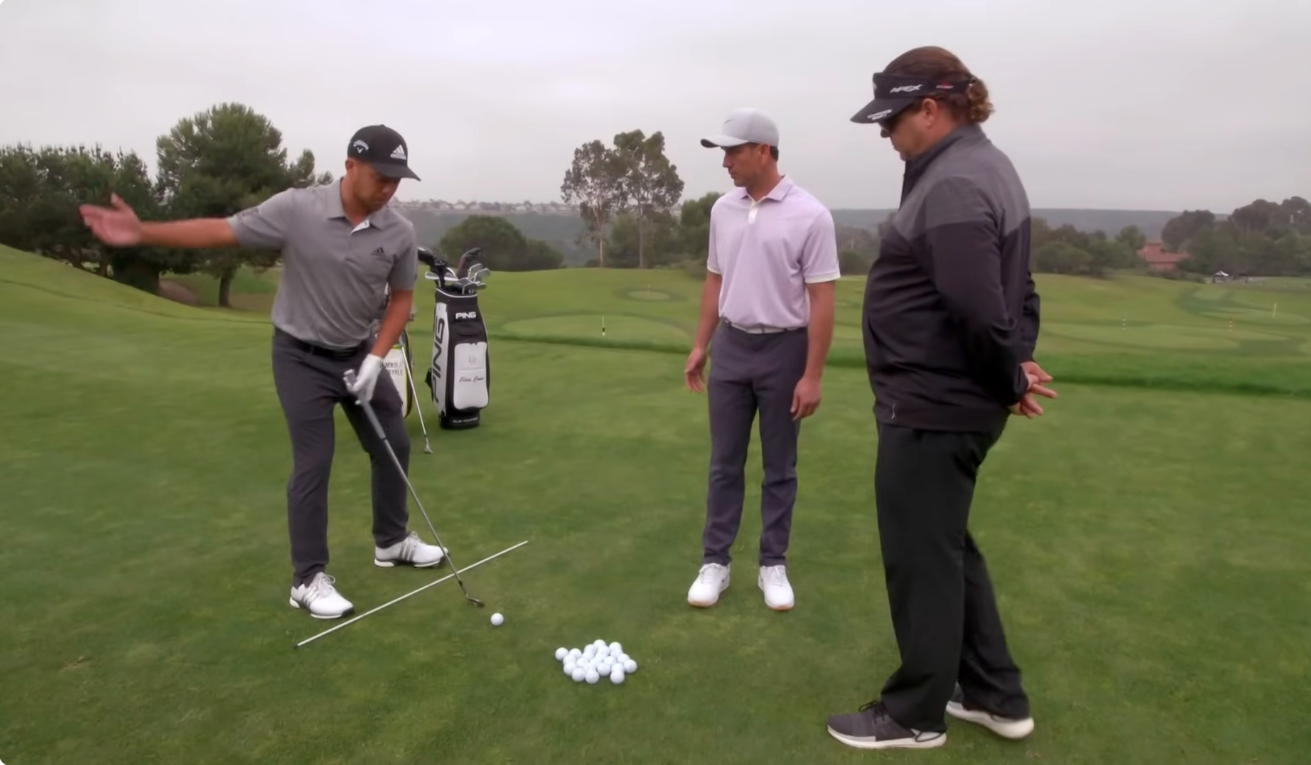
Walk onto the range at any professional event and you’ll see the same thing in front of almost every player: a couple of alignment sticks laid on the turf. One points down the target line. Another sits across it, marking exactly where the ball should be relative to the feet. And somewhere just behind the player, more often than not, there’s a coach - watching, nudging, checking that the setup is right before every single ball gets struck.
Now picture the average golfer on a Saturday morning. No sticks. No coach. They plant their feet once, settle in, and work through the bag - driver, irons, wedges - from more or less the same position every time. The swing gets all the attention. The setup gets none.
That gap is the whole story. And it has very little to do with talent.
The thing hiding in plain sight
Setup is the part of golf everyone is taught once and then quietly forgets. A lesson covers grip, stance and ball position in the first ten minutes, the instructor says “good,” and from then on every conversation is about the swing - the takeaway, the transition, the follow-through. Setup gets treated as a solved problem.
The trouble is that it isn’t solved. It’s just invisible. Most golfers have had the experience of striking it beautifully one week and spraying it the next, with no obvious change to their swing. They walk off wondering what happened. More often than not, nothing happened to the swing at all. Something shifted in the setup - a little narrower here, the ball a touch further back there - and it was never noticed because nobody was looking.
Setup is the most foundational skill in golf and, for amateurs, the most neglected. Everything that follows is built on it. If the foundation moves, the house moves with it.
What actually changes across the bag
Here’s the part most golfers were never properly shown: your setup is supposed to change from club to club. Not randomly, but in a consistent, predictable way across the bag.
Ball position moves. With the wedges, the ball sits roughly in the middle of the stance. As the clubs get longer, the ball moves progressively forward, until with the driver it’s played up off the lead heel. Stance width changes too - narrow for the short clubs, widening as the club gets longer and the swing gets bigger.
There’s a reason for all of it. Each club is built to strike the ball at a different point in the swing arc. Wedges and short irons are designed to be hit with more of a descending blow, ball-then-turf, which is why the ball sits back and the stance stays compact. The driver is the opposite - you want to catch it on a slight upswing, which is why the ball moves forward and the stance widens to support a fuller turn. Move through the club groups - wedges, short irons, mid irons, long irons and hybrids, fairway woods, driver - and the correct position shifts a little at each step.
It’s not complicated. But it’s specific. And “specific” is exactly what gets lost when a golfer uses one comfortable setup for most of the bag.
Why “one setup for everything” quietly costs you
This is the mistake hiding inside most amateur bags: one default stance, used for every club, because it feels familiar. The wedge setup creeps into the short irons. The mid iron setup creeps into the long irons. Nothing feels wrong, so nothing gets flagged.
The cost shows up downrange, where it’s hard to trace back. Research into ball-striking has found that being just one ball-width off in your position at address can add an additional 18 yards to your dispersion (with a mid iron at 140m) - that’s the difference between the middle of the green and the fringe, or worse the bunker, from a setup error you never felt. Setup inconsistency can also quietly cost ⅓ to ½ a club of carry distance. None of that loss happens during the swing. It’s already baked in before the club even moves.
That’s the uncomfortable truth: a good swing from a poor setup still produces a poor shot. The leak starts at the feet.
If that’s landing, it’s worth understanding what better players actually do about it - because the fix is more straightforward than another swing overhaul.
The harder part: doing it the same way twice
This is where the alignment sticks come back in. Better players use them precisely because they make setup visible - a physical reference on the ground for the target line and ball position, so the guesswork is removed and the same setup can be repeated swing after swing.
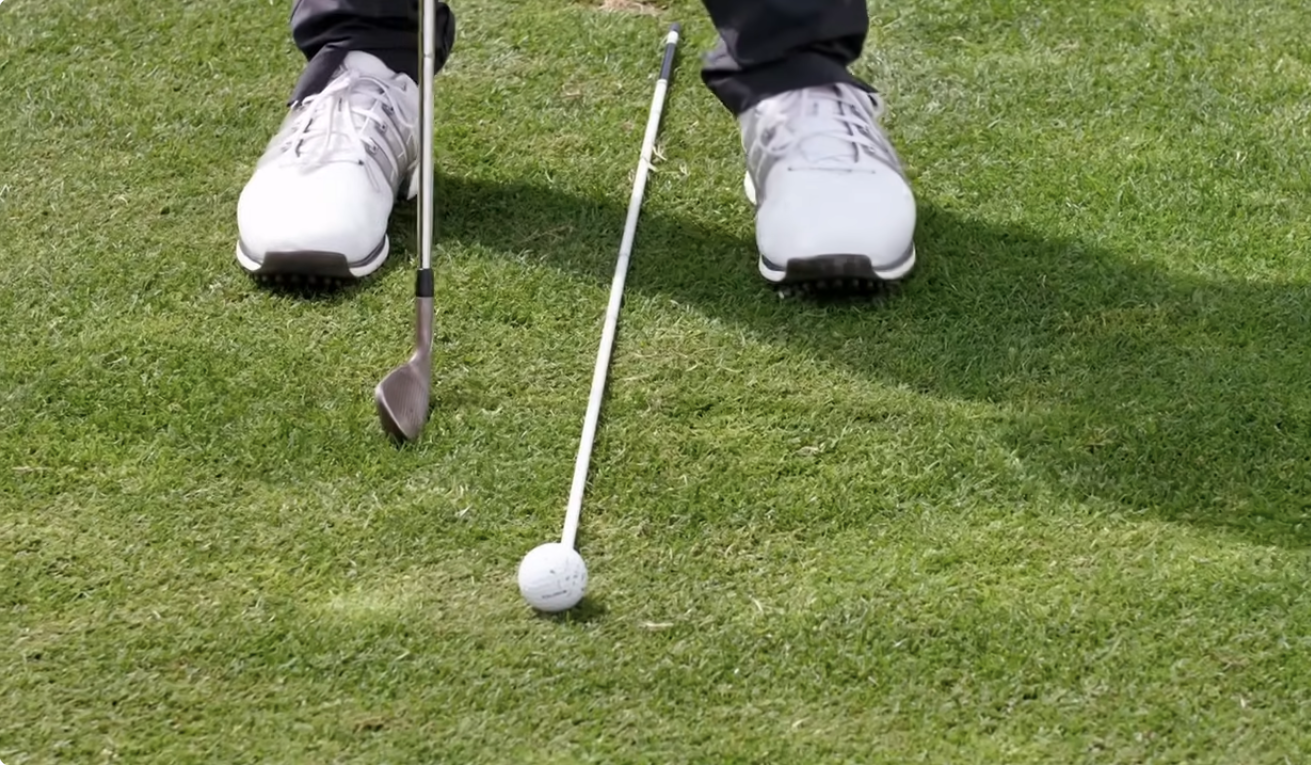
But there’s a catch the sticks don’t solve. An alignment stick only helps if the golfer already knows, or has a coach that already knows the right answer: the correct stance width for that club, and exactly where the ball should sit within that stance. The stick marks the position - it doesn’t tell you what the position should be. For a tour player, that knowledge is supplied by years of practice and a watchful eye over the shoulder. For most amateurs, it’s a guess, and a guess that drifts.
And drift is the real problem. Setup doesn’t fall apart all at once. It creeps - a few millimetres at a time, week over week - until one day the good form is gone and there’s no obvious reason why. The golfer who knows the positions still has to reproduce them precisely, every session, with nothing to check against. That’s far harder than it sounds.
It’s why some golfers have started using a physical reference they can simply lay down.
How golfers are closing that gap
In order to be able to repeat a setup consistently, you need a way to measure it and refer to it again during the next range session. For those with the means, this could be access to regular coaching sessions. For others it could be as simple as marks on an alignment stick, or throwing a tape measure down. Either way if you’re serious about developing consistency, you need to be consistent.
One example we found is Stance IQ, a mat built around exactly this principle. It takes the knowledge a tour player gets from a coach - what the setup should be for each club - and puts it on the ground where any golfer can use it.
Who actually needs to think about this
Not everyone. A plus handicap golfer with a regular coach probably already has an ingrained, repeatable setup and doesn’t need a reminder of where the ball goes.
But two groups stand to gain a lot. New golfers, who are still building habits and would rather build the right ones than spend two years grooving a default stance they’ll have to undo later. And experienced players whose ball-striking comes and goes - the ones who’ve tried everything on the swing and never thought to check the foundation underneath it. For both, the issue usually isn’t effort or talent. It’s that nobody is standing over their shoulder making sure the setup is right.
The part that’s actually within your control
Setup is the one fundamental in golf that doesn’t require more clubhead speed, more flexibility, or more range time to fix. It just requires attention.
The real difference between the player on the Tour range and the player on a Saturday morning isn’t what happens during the swing. It’s everything that happens before it - the sticks, the coach, the relentless checking that the setup is right every single time. That scaffolding is why their good shots repeat and their bad weeks are rare.
The good news is that it’s learnable. Pay attention to your setup. Notice whether your stance and ball position actually change across the bag, or whether you’ve been using one position for everything. Build in a way to check it, so it stays consistent instead of drifting. Do that, and you’re working on the same thing the best players in the world obsess over - the foundation that everything else is built on.